- Aadya Chaturvedi
Back
Google's AI vs. Publishers: The Next Abuse of Dominance Battle
Introduction
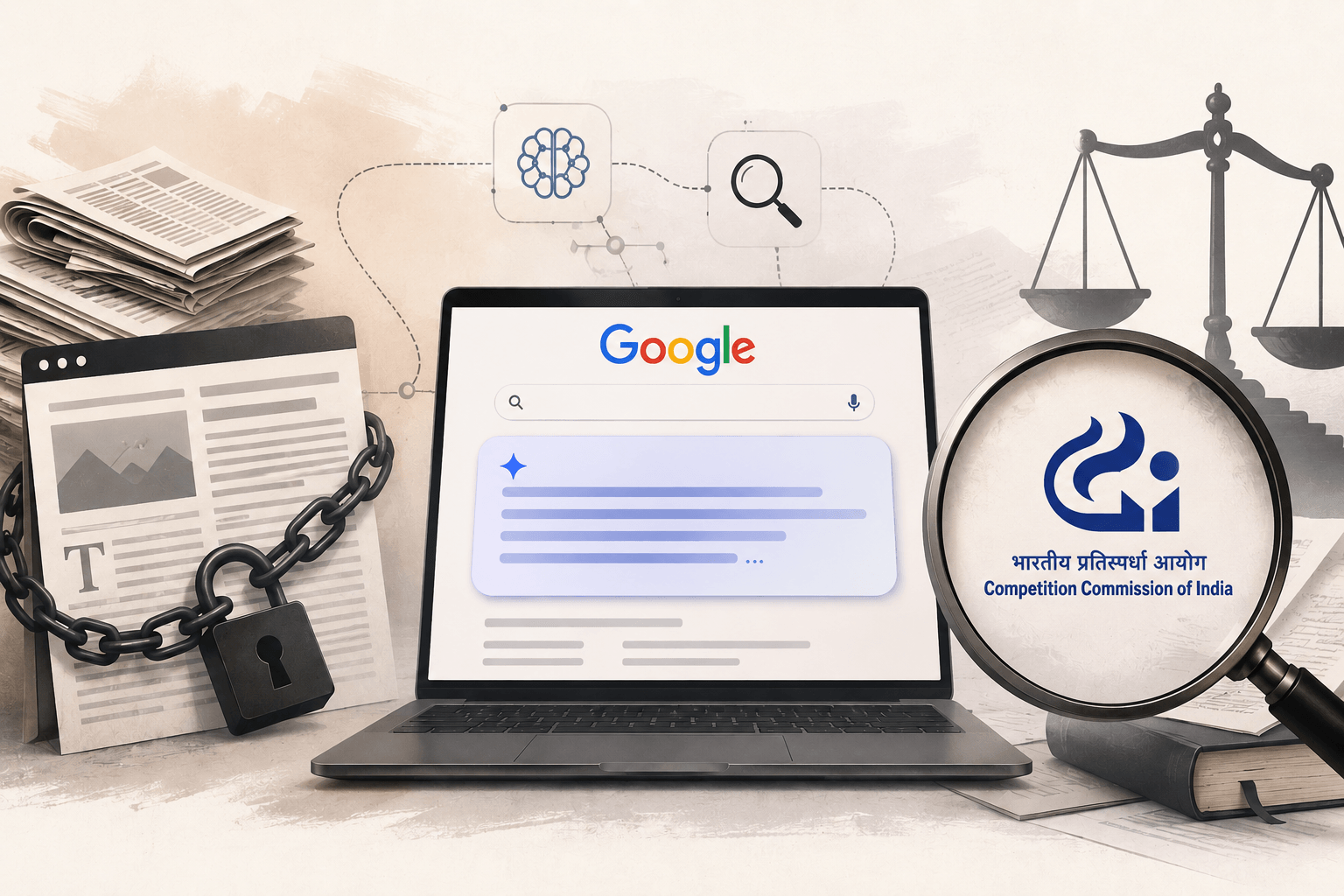
A recent complaint reportedly filed by Dainik Bhaskar Corporation Limited (“DB Corporation”) along with other publishers before the Competition Commission of India (“CCI”) against Google LLC (“Google”) marks yet another development in the ongoing investigation in respect of a similar complaint filed by the Digital News Publishers Association (“DNPA”) in 2021, alleging abuse of dominance by Google. The complaint appears to arise in a technological environment transformed by the introduction of artificial intelligence by Google in its search results, a feature known as AI Overview, which has intensified existing concerns around opacity in revenue allocation and zero-click searches that reduce traffic routing to publisher websites while increasing Google’s ability to monetize user engagement.
This article seeks to analyze the implications of the recent complaint and the complications it adds to the DNPA investigation, as well as the need to draw guidance from the digital competition laws of the European Union (“EU”) and the United Kingdom (“UK”) due to the gap left by the withdrawal of the Digital Competition Bill, 2024 (“DCB”) in India.
Background
In 2021, the DNPA had claimed that publishers were not given any data to substantiate the amount of revenue earned by Google through advertisements on the websites of such publishers, nor were they informed of any basis for the calculation of their share of such revenue. Another critical averment denounced the surge in zero-click searches due to ‘snippets’ or extracts of the original news article displayed by Google on the results page, which resolved the users’ queries without them having to click on the source link. The DNPA alleged that this mechanism allowed Google to extract revenue from zero-click searches, while publishers lost out on critical traffic.
Against this background, the reported complaint by DB Corporation, among others, would presumably raise concerns surrounding Google’s AI Overview feature which synthesizes results from a search query and provides an AI-generated summary of such relevant results. While this would pose concerns similar to those cited in the DNPA complaint in respect of zero-click searches, it amplifies their impact by further depressing traffic to source websites. This is supported by a study published in February 2026 by Ahrefs, which found that the presence of an AI Overview correlates with a 58% lower average clickthrough rate for a top-ranking page.
Separately, another complaint in respect of Google’s advertising policies was filed by the Alliance of Digital India Foundation in 2024, and a part of it was clubbed into the DNPA investigation. Given the overlap in the parties involved and the underlying competition concerns, the complaint by DB Corporation and others may similarly be consolidated with the ongoing investigation.
Legal Remedies
In the DNPA investigation, the CCI directed an investigation into alleged violations of Section 4(2)(a) of the Competition Act, 2002 (“Act”) committed by Google, with a prima facie finding that the display of ‘snippets’ to the detriment of original publishers constituted an imposition of unfair conditions and prices. In contrast to such ‘snippets’, AI Overviews paraphrase the original content in order to synthesize multiple sources, and the attributability to a specific publisher may become difficult to establish, further distorting a clear portion of revenue allocable to such publisher. Further, the DNPA investigation also examines the alleged violation of Section 4(2)(e) of the Act with regard to Google leveraging its dominant position in the market for online general web search services to enter into and protect its position in the market for news aggregation services. Depending on factual findings, similar concerns may arise with regard to potential allegations of Google using its dominant position in the relevant markets to enter/ protect its position in the market for AI-enabled search services.
Here, it is helpful to look to the recent steps taken by the UK Competition and Markets Authority (“CMA”), which has used its powers under the Digital Markets, Competition and Consumers Act, 2024 (“DMCCA”) to designate Google with ‘strategic market status’and impose mandatory conduct requirements (“CRs”). CRs function as ex-ante controls tailored to specific companies which have received strategic market status, and are formulated by the CMA after extensive market assessments of such companies. In June 2026, the CMA imposed a publisher CR on Google, compelling it to provide publishers with control over the use of their original content in AI Overviews. Under this framework, the publishers may refuse use of their content to provide an AI Overview without being penalized in ordinary search results. Further, Google is now required to provide clear information on how publisher content is used in such AI Overviews, as well as to provide metrics on user engagement with specific publisher content. Lastly, the CR mandates clear attribution, along with a mechanism enabling users to access the underlying publisher content.
The European Commission in December 2025 initiated an investigation into Google’s use of publisher content for the purposes of AI Overviews. Furthermore, under the EU’s Digital Markets Act, 2022 (“DMA”), Google is a designated ‘gatekeeper’ for numerous digital services and is subject to ex-ante obligations such as fair and transparent dealing with end-users, prohibition on self-preferencing, and restrictions on tying and bundling.
It is relevant to note that India’s DCB provided for a similar concept of Systematically Significant Digital Enterprises (“SSDEs”) operating in designated core digital services deemed susceptible to concentration, including online search engines. These SSDEs would be subject to ex-ante obligations analogous to those enshrined in the DMA. Designation was based on a dual threshold comprised of financial parameters (turnover in India of not less than 440 million euros and a global turnover of not less than USD 30 billion) and user traffic (at least 10 million end users or at least 10,000 business users in India). This framework was criticized on two principal grounds. First, the low quantitative threshold risked disproportionately impacting growing Indian digital firms. Secondly, the prescribed list of core digital services was considered overly broad and included sectors that were relatively competitive. Another limitation of the DCB was that, unlike the DMA and DMCCA frameworks, it did not confer special investigatory powers upon the CCI to assess whether a specific firm actually had entrenched market power and strategic significance before designating it as an SSDE, as it relied predominantly on quantitative criteria.
Conclusion
In light of developments in other jurisdictions which have engaged with and investigated Google in an antitrust context, and the recent complaint filed by DB Corporation, guidance may be taken from the DMA and the DMCCA to anticipate the behavioural remedies which may now be imposed, considering the introduction of AI in Google’s interface during the pendency of the DNPA investigation and the CCI’s increased focus on AI as evidenced by its recent market study on ‘Artificial Intelligence and Competition’. At the same time, supplementing such ex-post remedies with an ex-ante legal framework tailored to the Indian digital landscape would provide greater regulatory certainty by setting a compliance benchmark for significant market players while allowing such enterprises to work in consultation with the CCI to alleviate competition concerns before they culminate into prolonged investigations and enforcement proceedings.